Take a break without being the family’s on-call manager.
An interactive family handoff tool for the mom who gets help but still manages everything. Start with one break: another adult accepts dinner and bedtime, owns routine decisions, and handles the follow-through in a shared Family Space. You decide together which interruptions can wait.
See how to use this system in an everyday situation before deciding whether it fits.
Illustrative example
Dinner during your break
Who is taking over?
Choose the adult on duty and agree on dinner, routine decisions and when an interruption is actually needed.
A handoff the other adult can accept, with routine questions parked for your return.
What you are actually buying
See the difference between taking a break and actually handing it off.
This is not another chore list. It is the moment decisions, questions and responsibility stop automatically routing back to Mom.
The fake break
Mom is sitting down. She is still managing everything.
Questions, decisions and reminders keep routing back to her. The break exists on paper, not in her head.
Interruptions to Mom
3
Current owner
Still Mom
Family Space · Live
Everything still routes to Mom
Mom still available
What still reaches Mom
Mom, what are we eating?
Sent to Mom · request 1
Where is my sports shirt?
Sent to Mom · request 2
The dog needs out. Who is doing it?
Sent to Mom · request 3
She is “on a break,” but she is still the decision center.
Click the stages to see what actually changes.
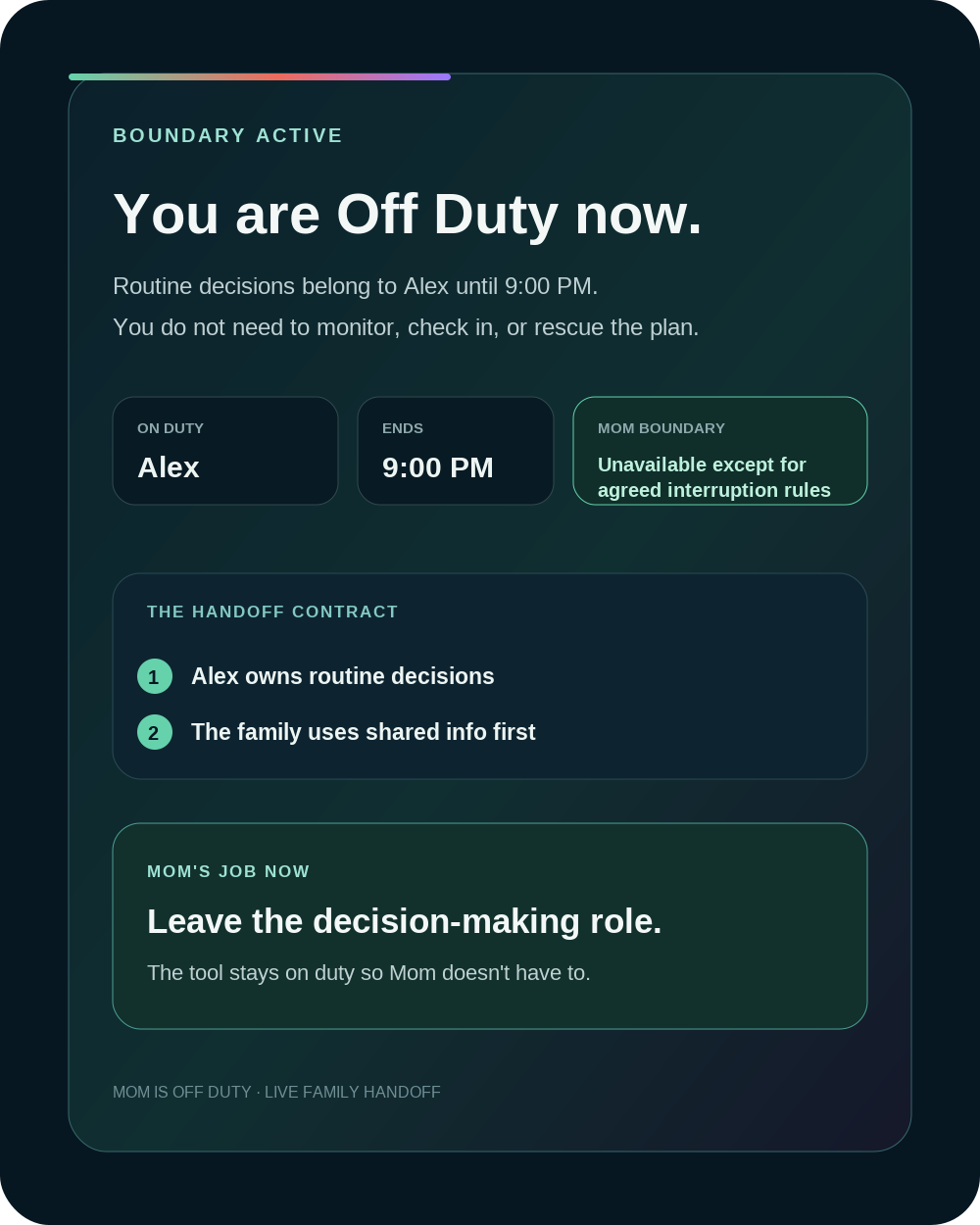
MOM IS OFF DUTY
Your next break can be a real transfer, not remote management.
Rules to protect your breakResponsibility explicitly transferredOne purchase for the premium household
Household access
$39.99
What you actually get
A role-aware Handoff Contract that tells every person who owns decisions now
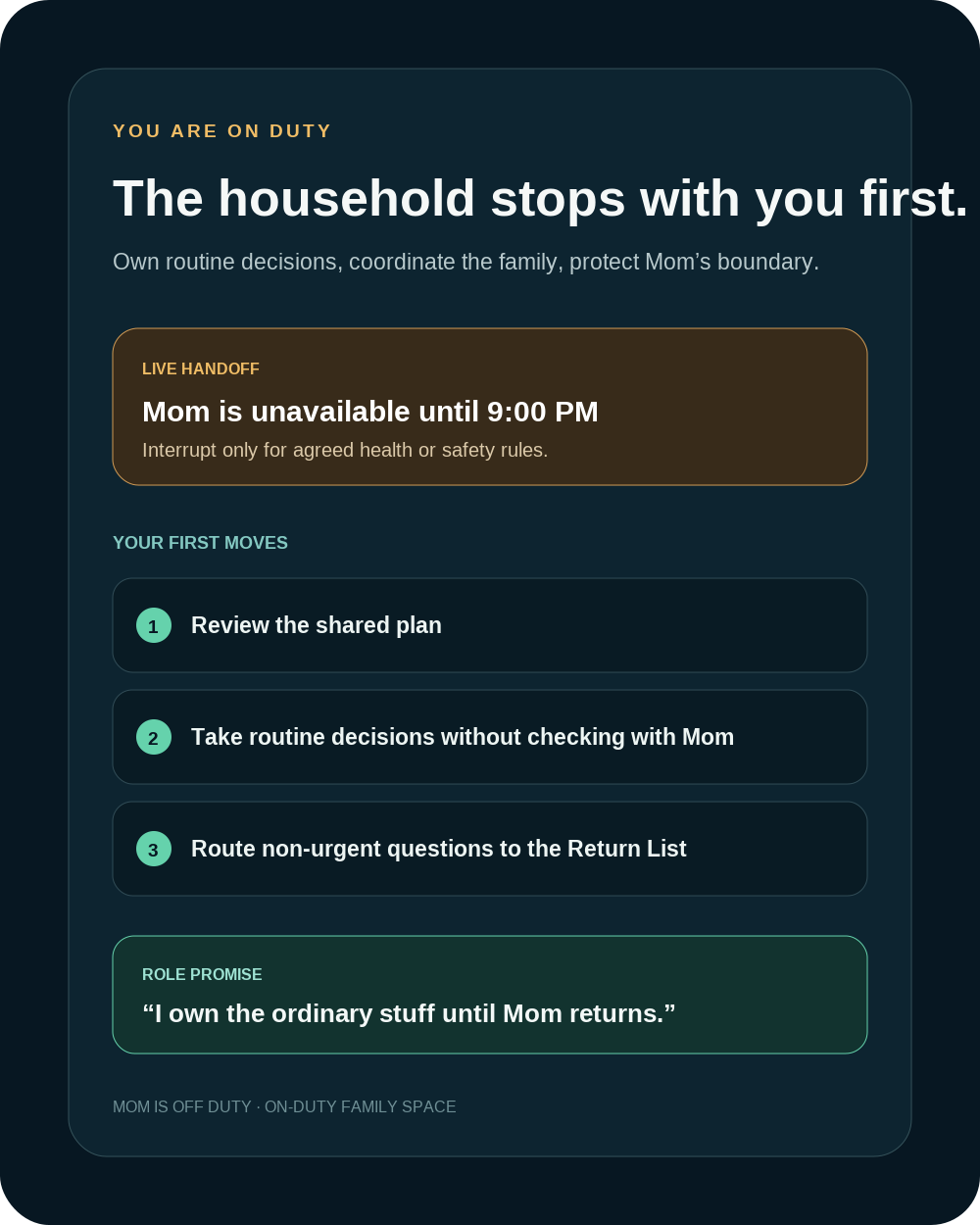
An On-Duty acceptance flow so responsibility is explicitly transferred, not vaguely assumed
Reusable household reference cards with role-based visibility
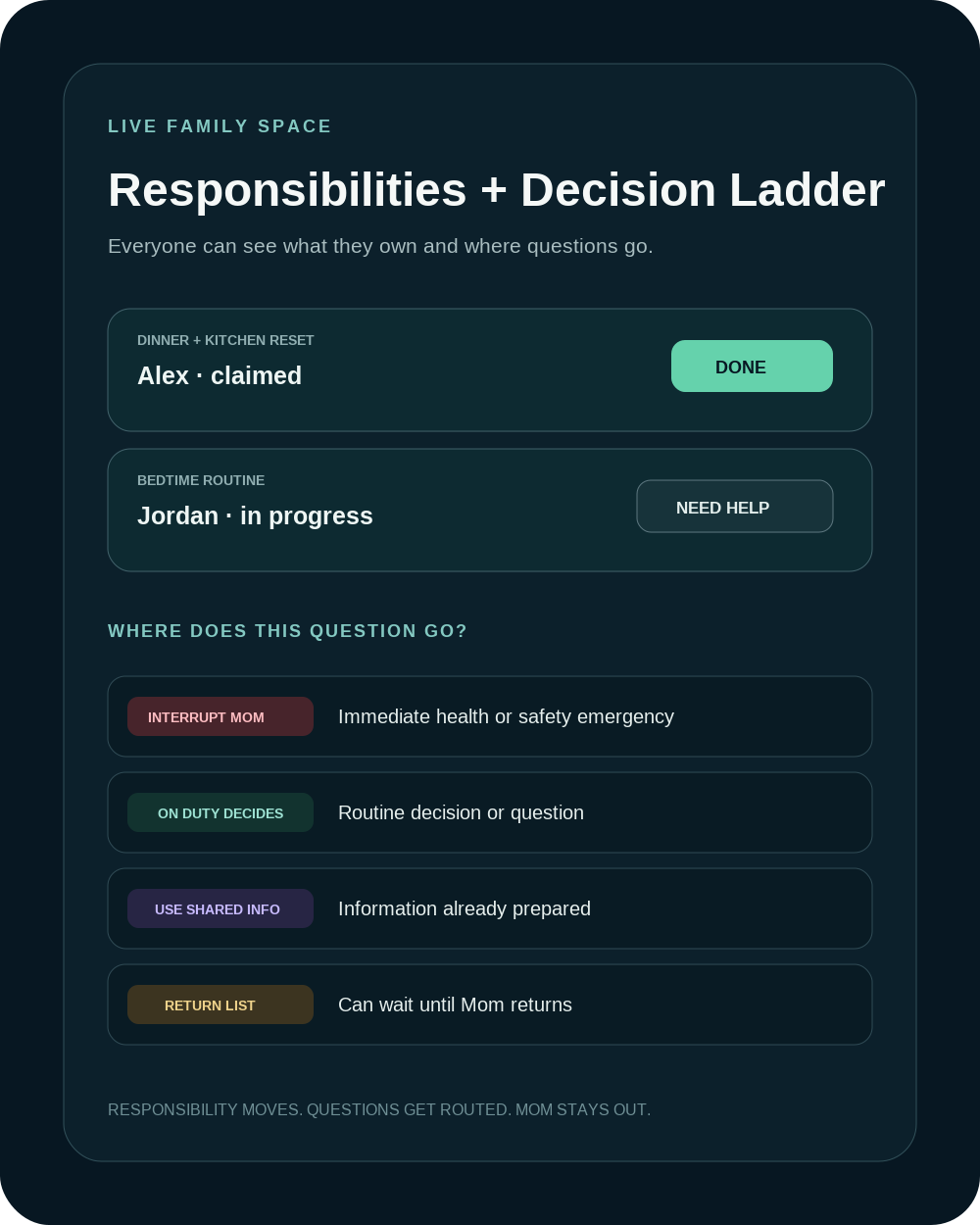
Editable interruption rules and a Decision Ladder for questions that come up
Live responsibilities with Done, Need Help, and Can’t Complete states
A Return List that parks non-urgent questions instead of sending them back to Mom
Three starter handoffs that preload real messages, rules, and responsibilities
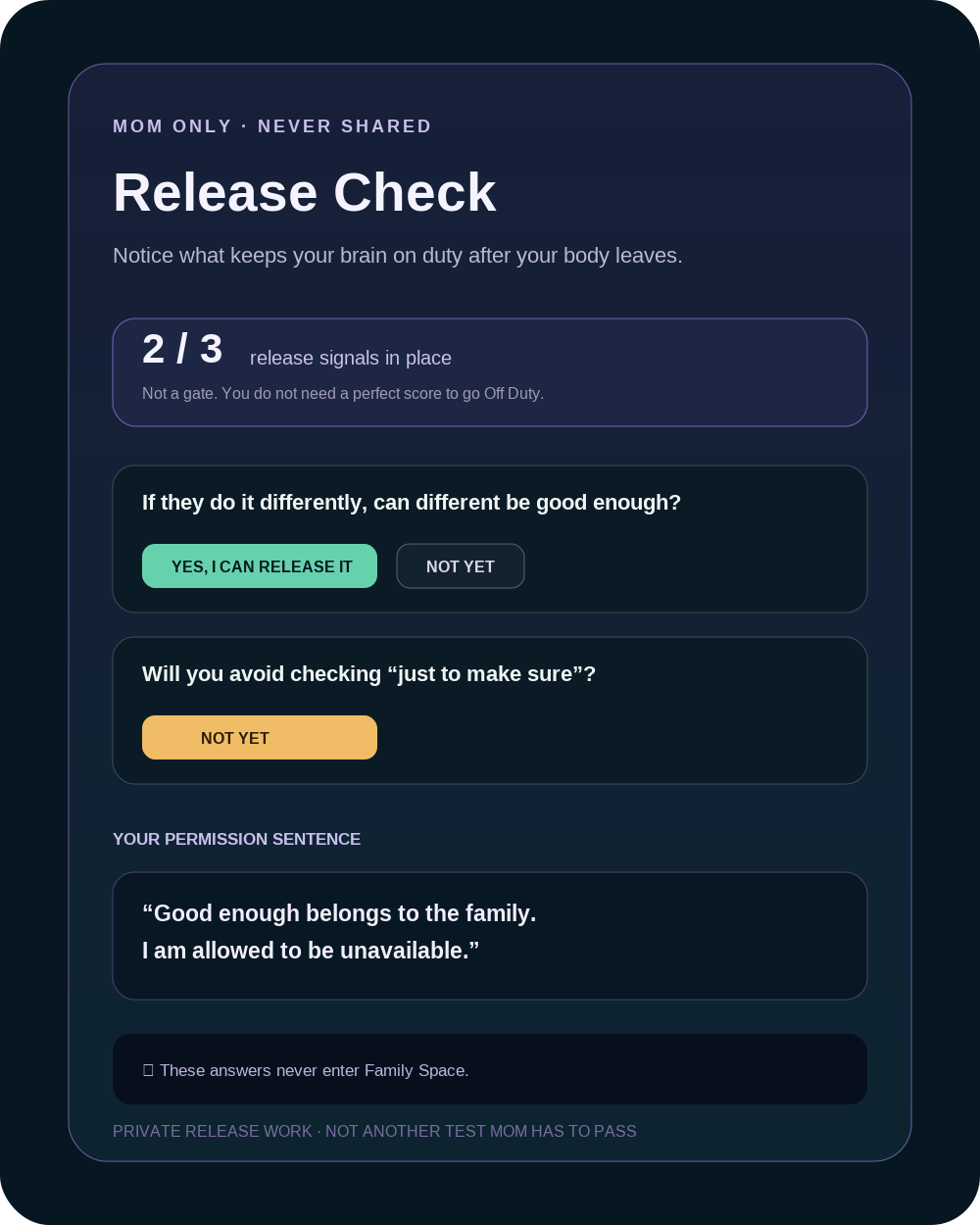
A private Release Check for guilt, control, checking, and the urge to rescue
A private post-handoff debrief that captures what worked without Mom
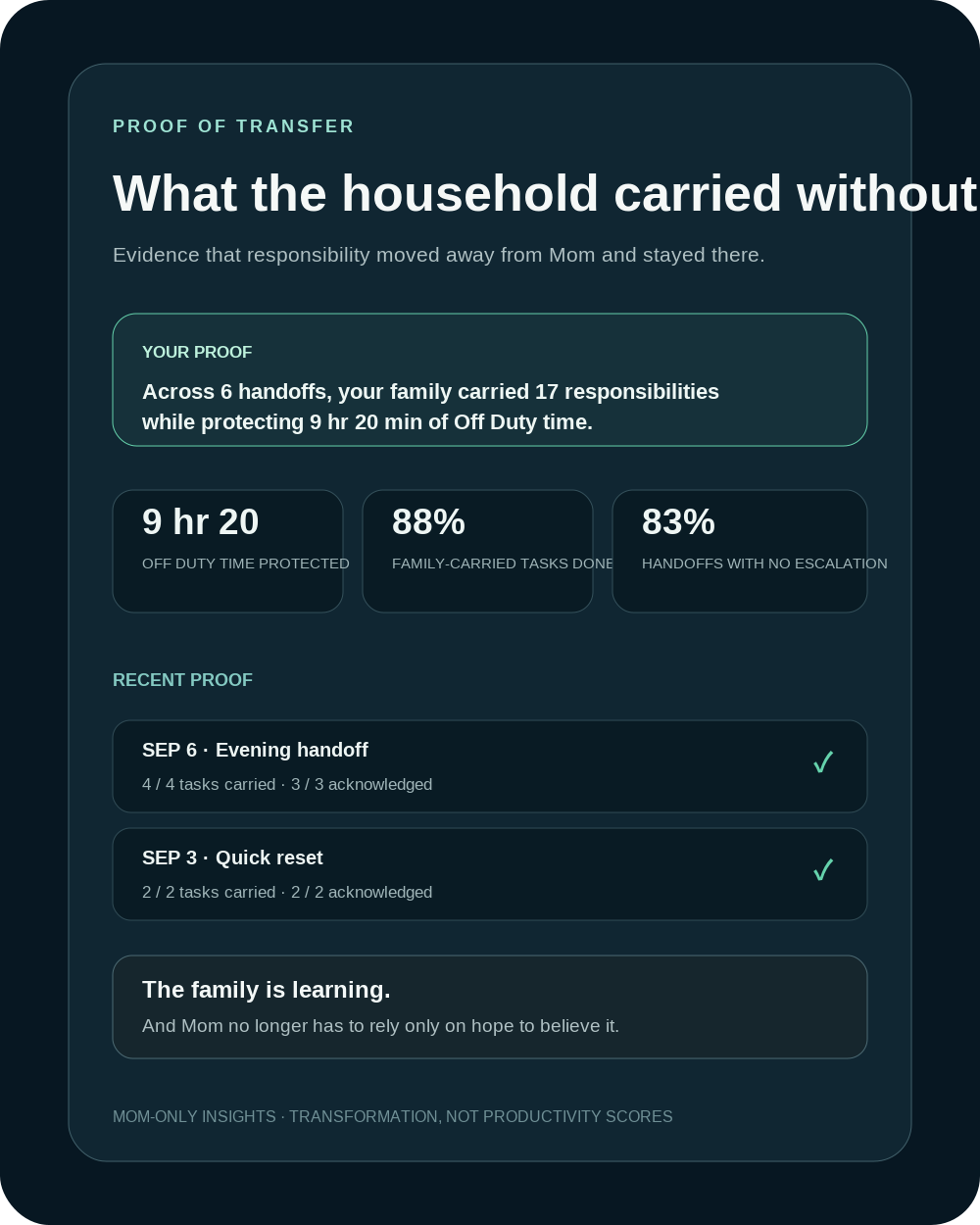
Proof-of-Transfer insights showing what the household actually carried
Optional AI Handoff Concierge to draft, stress-test, or simplify the family-facing plan
Secure invitations and participant-only access to live handoff information
See the actual system before you buy
These illustrated previews explain the handoff contract, On-Duty space, responsibility board, private Release Check and Proof of Transfer. Try the interactive demo below to see how a handoff works before you decide.
Expand preview
Expand preview
Expand preview
Expand preview
Expand preview
The handoff in four moves
The system is designed to reduce Mom’s thinking, not create a new household-management job.
01 · Choose
Name On Duty
Choose the adult or caregiver who owns routine decisions.
02 · Release
Share only what matters
Select participants, shared information, and responsibilities.
03 · Protect
Set the interruption rules
Decide in advance what reaches Mom and what does not.
04 · Transfer
Send and step out
On Duty accepts. The Family Space becomes the operating center.
For the Mom who gets help but still carries the responsibility
You can leave the room but questions, decisions and reminders still follow you
Your partner or family helps with tasks, but you remain the default decision-maker
You want the remembering and follow-through transferred too, not just the final chore
You need a clear On-Duty person instead of everyone assuming Mom is still the backup
You want the household to practice functioning without constant maternal monitoring
What this is not
It is not a chore chart, calendar, therapy replacement, emergency service, or surveillance tool. It is a structured family responsibility-transfer system.
Before you hand it off
Don’t just take a break. Hand it off.
Make the next break a real transfer of household responsibility, not remote management from another room.
Digital interactive product. Secure account required. One premium household per purchaser entitlement.
A calm household planning app with weekly forecasts, calendars, responsibility sharing, guided reviews and private household conversations. One-time base purchase; optional monthly extras will be offered separately.
A premium co-parenting mental-load system for making invisible planning, follow-up and cross-household responsibility visible, then assigning clear ownership without turning parenting time into a scorecard.
Being off duty is not the same as being out of the room
A default parent can leave the kitchen, close the bedroom door or go out for an hour and still remain the person carrying the household in their head. The mental load is the invisible labor of noticing what needs to happen, remembering it, deciding what comes next, answering questions and making sure nothing falls through the cracks. That is why a physical break can still feel like being mentally on call.
What is the default-parent mental load?
It is more than doing a larger share of chores. It is being the family’s first responder, planner, memory bank and backup system. If everyone knows Mom will notice the missing form, remember the appointment, answer the question or rescue the routine, responsibility keeps routing back to her even when other people are willing to help.
Why delegating chores does not transfer ownership
Delegation can reduce physical work while preserving the management job. If Mom still has to notice the task, assign it, explain it, remind someone and check the result, she still owns the mental load. Sharing the mental load with a partner means transferring the remembering, decisions and follow-through too, not simply handing over the final visible step.
What a real family handoff transfers
A complete family handoff moves household responsibility for a defined window. Another adult accepts On Duty, the family can see what it owns, routine questions stop bouncing back to Mom, and non-urgent issues can wait. The goal is not perfection. The goal is a household that can make ordinary decisions without keeping one default parent as the invisible command center.
How Mom Is Off Duty changes the operating pattern
Mom Is Off Duty is designed for families that already understand the problem and need an implementation system. It turns transfer ownership into a visible process: define what is moving, name the On-Duty person, share only the information that is needed, set interruption rules, and let the family carry the responsibility until the handoff ends. For a mom trying to mentally switch off, reduce default-parent burnout or stop being the default parent for a real block of time, the important change is not doing fewer chores for one evening. It is no longer being responsible for remembering and managing everyone else’s next move.
Related practical guides
Understand the mental load before handing it off
These guides connect the default-parent role, invisible reminders, difficulty switching off and real responsibility transfer across the whole family.